What is Sleep apnea?
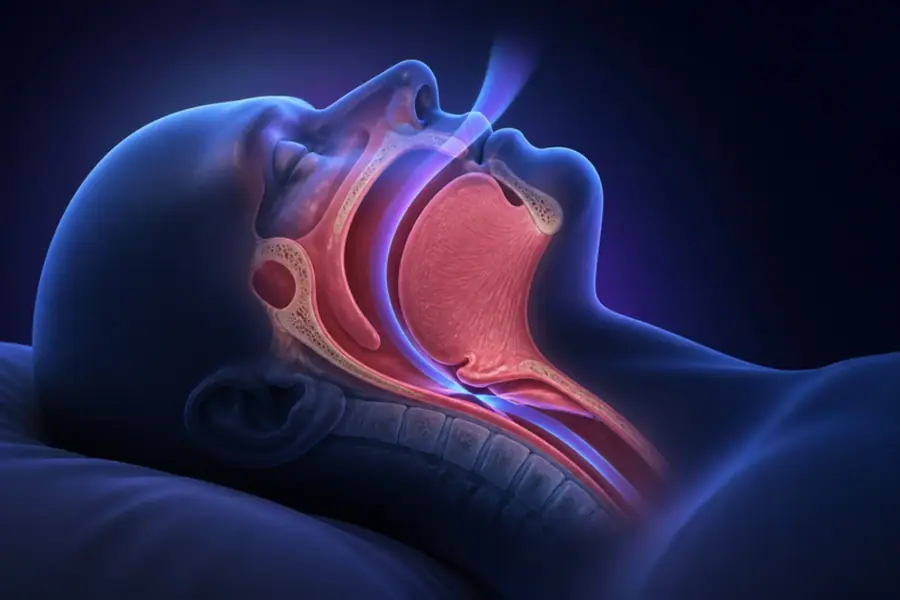
During sleep, the muscles of the throat naturally relax. In some people this relaxation causes the airway behind the tongue and soft palate to narrow or collapse completely. A narrowed airway causes snoring; a closed airway causes breathing to stop (apnea) or become very shallow (hypopnea). Oxygen in the blood falls, the brain briefly wakes the person up and breathing starts again. This cycle can repeat dozens or even hundreds of times a night — usually without the person remembering.
Obstructive sleep apnea — caused by mechanical blockage of the airway — is by far the most common form. In central sleep apnea, the brain does not send regular signals to breathe; it is linked with heart failure, stroke and some medicines. Some people have both.
Severity is measured by the number of apneas and hypopneas per hour of sleep (the apnea–hypopnea index, AHI): 5–15 per hour is mild, 15–30 moderate and 30 or more severe.
Sleep apnea is much more than “a snoring problem”. Untreated, it increases the risk of high blood pressure, heart rhythm disorders (especially atrial fibrillation), heart attack, stroke, insulin resistance and type 2 diabetes. Daytime sleepiness raises the risk of road and workplace accidents. It is also linked with poor memory, poor concentration and low mood — which is why it should always be considered in older people with memory complaints.
Symptoms of Sleep apnea
At night
- Loud, irregular snoring
- Breathing pauses noticed by a partner, followed by gasping or choking
- Frequent awakenings, waking with a choking feeling
- Getting up to pass urine at night
- Sweating and restless sleep
- Dry mouth and night-time reflux
During the day
- Waking unrefreshed despite a long night in bed
- Excessive sleepiness — dozing in meetings, in front of the TV or even while driving
- Morning headaches
- Poor concentration and memory
- Irritability and low mood
- Reduced sex drive
In women, sleep apnea often presents less typically — with insomnia, fatigue and morning headaches — and can be missed. It becomes much more common after the menopause.
When should you see a neurologist?
An assessment for sleep apnea is recommended if one or more of the following applies:
- Snoring with breathing pauses noticed by a partner
- Daytime sleepiness, especially dozing while driving
- Excess weight and a large neck (over 43 cm in men, 40 cm in women)
- High blood pressure that is hard to control despite medication
- Atrial fibrillation, heart failure or previous stroke
- Type 2 diabetes and metabolic syndrome
- Morning headaches and unexplained fatigue
- Memory and concentration problems, particularly in older age
- Suspected sleep apnea before surgery
If you are dozing at the wheel, avoid long drives until you have been assessed and treated — for your own safety and that of others.
How is Sleep apnea diagnosed?
The assessment starts with a detailed consultation about your sleep habits, snoring and daytime sleepiness. It helps enormously if your partner — or someone who has seen you sleep — can join. Standard questionnaires such as the Epworth Sleepiness Scale are used, and we examine neck size, weight, nose and throat, and blood pressure.
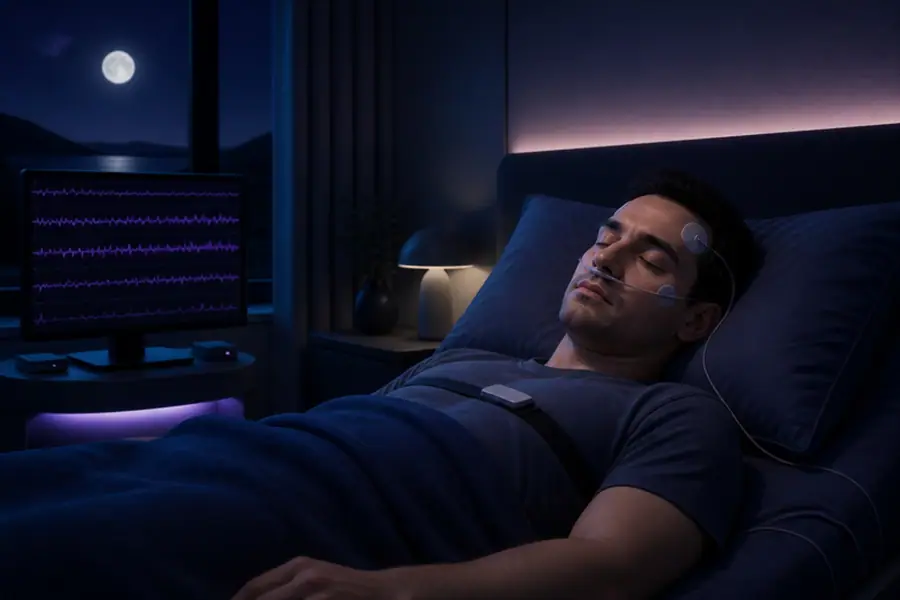
The diagnosis is confirmed by polysomnography (a sleep study). During one night in the sleep laboratory we record brain waves, eye movements, muscle activity, airflow through the nose and mouth, chest and abdominal breathing movements, blood oxygen, heart rhythm, snoring, body position and leg movements. The study shows whether sleep apnea is present, which type it is, how severe it is and whether it is worse in certain positions or sleep stages.
Simpler home sleep tests can be used in selected patients, but they do not record brain waves, so they cannot show sleep structure and may miss milder cases. A full laboratory polysomnography is preferred if another sleep disorder is suspected.
How is Sleep apnea treated?
Treatment depends on severity, type, your symptoms and other health conditions.
CPAP
For moderate and severe obstructive sleep apnea, the main treatment is CPAP (continuous positive airway pressure). A small machine delivers gently pressurised air through a nasal or full-face mask, keeping the throat open during sleep. With the right pressure and a well-fitting mask, breathing pauses, snoring and daytime sleepiness improve markedly. The correct pressure is set with a titration study in the sleep laboratory or with an auto-adjusting device. BiPAP devices are used when higher pressures are needed or breathing is insufficient.
Other options
- Weight loss can substantially reduce sleep apnea in people who are overweight
- Positional therapy for apnea that occurs mainly when lying on the back
- Mandibular advancement devices made with a dentist, for mild to moderate apnea or people who cannot use CPAP
- ENT assessment for nasal blockage, large tonsils or structural problems
- Avoiding alcohol and sedatives, which relax the throat muscles
Neurological follow-up
After treatment starts we follow daytime sleepiness, attention, memory and mood. If sleepiness persists despite good CPAP use, other causes such as narcolepsy are investigated. In patients with stroke, dementia or Parkinson’s disease, treating sleep apnea is an important part of neurological care.
Treatment timeline and your stay in Istanbul
The first consultation takes about 45 minutes. The sleep study is done overnight: you arrive in the evening and leave in the morning. The report is ready within a few days. If CPAP is needed, a second titration night may be arranged, or treatment is started with an auto-adjusting device and checked.
For international patients, the consultation, sleep study and — if needed — CPAP set-up can usually be completed in a 2–3 day stay in Istanbul. Device data can then be monitored remotely or reviewed by video call.
Follow-up after treatment
The key to CPAP success is regular use: every night, for most of the night. Getting used to the mask takes time; early problems can usually be solved by changing the mask, adjusting humidification or fine-tuning the pressure.
- First review usually after one month, with analysis of the device’s usage data
- Regular cleaning and replacement of mask, tubing and filters
- Pressure is re-assessed after weight change, new illnesses or if symptoms return
- Yearly check-ups are recommended
Risks and what to watch for
Untreated sleep apnea increases the risk of high blood pressure, heart rhythm problems, heart attack, stroke, diabetes and road accidents, so treatment should be planned once the diagnosis is made.
CPAP is generally safe. Possible problems include pressure marks from the mask, nasal congestion or dryness, a dry mouth, air leaks and difficulty getting used to it at first. Most of these can be solved with a better-fitting mask, heated humidification and pressure adjustments.
Frequently asked questions about Sleep apnea
Does everyone who snores have sleep apnea?
No. Snoring is very common and not everyone who snores has sleep apnea. If snoring comes with breathing pauses, daytime sleepiness, morning headaches or high blood pressure, an assessment is recommended.
How is sleep apnea diagnosed?
With polysomnography (a sleep study). Breathing, oxygen levels, brain waves and other signals are recorded through the night to measure how often breathing stops and how severe it is.
Will I need CPAP for life?
CPAP does not cure sleep apnea; it keeps the airway open while you use it. In some people, weight loss or other changes reduce severity, and treatment can be adjusted after a new sleep study.
Does sleep apnea increase the risk of stroke?
Yes. Untreated moderate to severe sleep apnea increases the risk of stroke through high blood pressure and heart rhythm problems. Sleep apnea is also common after a stroke and its treatment matters for recovery.
Can sleep apnea cause memory problems?
Fragmented sleep and repeated drops in oxygen can affect attention, concentration and memory. In older people with memory complaints, sleep apnea should be looked for and treated.
Does losing weight cure sleep apnea?
In people who are overweight, weight loss can markedly reduce sleep apnea and may remove the need for treatment in some mild cases, but it is not enough for everyone. The change is confirmed with a new sleep study.
Can surgery treat sleep apnea?
Surgery can help selected patients with specific nose, tonsil or palate problems. In adults with moderate to severe sleep apnea, CPAP is usually the main treatment. Surgical options are assessed with an ENT surgeon.
Can I come to Istanbul for a sleep study?
Yes. After a pre-consultation, the consultation, polysomnography and CPAP start can usually be scheduled into a 2–3 day stay, with follow-up continuing online.
This page is for general information only and does not replace a medical consultation. Please consult a physician for diagnosis and treatment. Results vary from person to person.