What is Evoked potentials (VEP, BAEP, SEP)?
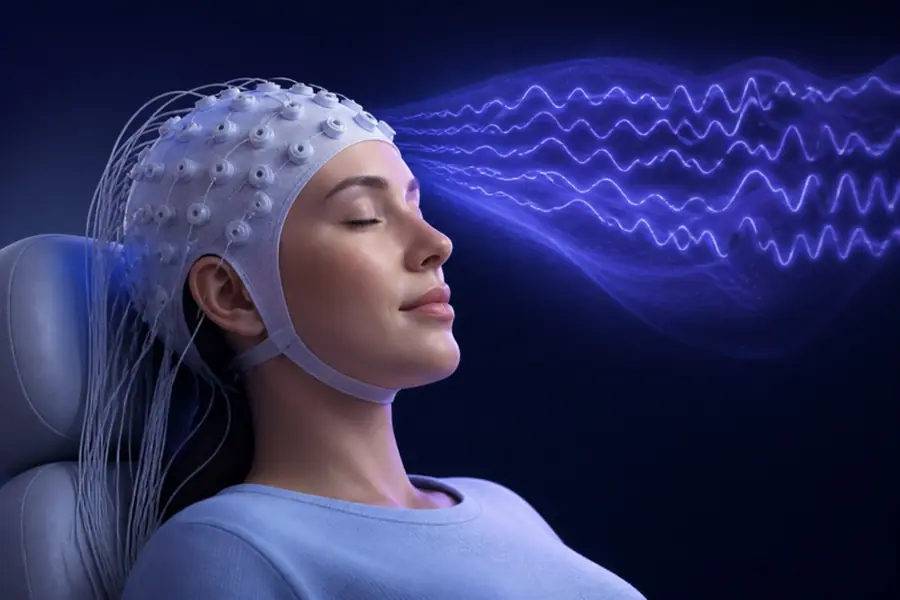
When the eyes see a pattern, the ears hear a sound or the skin is touched, a signal travels along nerve pathways to the brain. Evoked potentials record the brain’s electrical response to such a stimulus through electrodes on the scalp. Because the response to a single stimulus is very small, hundreds of responses are averaged by a computer to produce a clear waveform.
The key measurement is latency — the time the signal takes to reach the brain. Slowed conduction suggests damage to the insulating myelin layer of the pathway, as occurs in multiple sclerosis. A reduced signal size suggests loss of nerve fibres.
Types of evoked potentials
- Visual evoked potentials (VEP): you watch a changing checkerboard pattern on a screen; this tests the pathway from the eyes through the optic nerves to the back of the brain
- Brainstem auditory evoked potentials (BAEP): you hear clicks through headphones; this tests the hearing nerve and the pathways in the brainstem
- Somatosensory evoked potentials (SEP): small electrical pulses are applied to a nerve at the wrist or ankle; this tests the sensory pathway through the spinal cord to the brain
- Motor evoked potentials (MEP): in selected cases, magnetic stimulation tests the motor pathway from the brain to the muscles
Why test pathways that seem to work normally?
Damage to the myelin layer can slow conduction without causing obvious symptoms, because the nervous system compensates very well. Evoked potentials measure conduction speed in milliseconds and can therefore detect subtle, previously unnoticed damage. This is particularly helpful when the diagnosis is uncertain — for example, when a person has had a single episode of numbness or visual blurring and the MRI findings are not conclusive.
When is it requested?
- Suspected or known multiple sclerosis
- Blurred vision, pain on moving the eye or reduced colour vision (optic neuritis)
- Numbness, tingling or balance problems suggesting spinal cord involvement
- Hearing loss, tinnitus or dizziness requiring assessment of the hearing nerve
- Unexplained visual loss with a normal eye examination
- Assessment of vitamin B12 deficiency affecting the spinal cord
- Monitoring of nerve pathways in certain neurological conditions
Who needs Evoked potentials (VEP, BAEP, SEP)?
Evoked potentials are safe at any age. For VEP, you need to be able to focus on a screen; bring your glasses or contact lenses. For BAEP, inform us if you have significant hearing loss. For SEP, inform us if you have a pacemaker.
Role in multiple sclerosis
MRI is the main test for multiple sclerosis, but evoked potentials can show damage in pathways that look normal on MRI or have never caused symptoms. For example, an abnormal VEP in a person who has never noticed visual problems can show a previous silent optic nerve inflammation, supporting the diagnosis of MS by showing involvement of more than one area of the nervous system.
How to prepare
- Wash your hair and do not use hair products
- Get a good night’s sleep before a VEP; tiredness can affect the test
- Bring your glasses or contact lenses
- Take your usual medicines
- Wear loose clothing for SEP so that the wrists and ankles are easily accessible
- Bring previous MRI and eye examination reports
How is Evoked potentials (VEP, BAEP, SEP) performed?
- Small electrodes are placed on the scalp and, for SEP, along the nerve pathway
- VEP: you look at the centre of a checkerboard on a screen, one eye at a time
- BAEP: you lie still with headphones on and hear clicking sounds in each ear
- SEP: mild electrical pulses are applied to the wrist or ankle, causing a small twitch of the thumb or toe
- You are asked to relax and stay as still as possible during each recording
- Each recording is repeated to ensure consistent results
Duration, results and your stay in Istanbul
Each type of evoked potential takes about 20–40 minutes; if several are performed together, the appointment can last up to 90 minutes. The report is usually available within one or two days.
For international patients, evoked potentials can be completed in one day in Istanbul, often together with a consultation and other tests.
After the test
- You can return to normal activities immediately
- Wash your hair to remove the paste
- The results are interpreted together with your MRI and examination findings
How the results are reported
For each pathway, the report gives the latency and amplitude of the main waves and compares the two sides. A delay on one side, a difference between the sides or an absent response is interpreted together with your symptoms, examination and MRI. The results do not give a diagnosis alone but help to complete the overall picture.
Risks and safety
Evoked potential tests are safe and non-invasive. The electrical pulses in SEP may feel slightly uncomfortable but are harmless. The paste may cause mild skin irritation in sensitive people. The flashing checkerboard used in VEP is not the same as the flashing lights used in EEG and is very unlikely to trigger seizures.
Frequently asked questions about Evoked potentials (VEP, BAEP, SEP)
Are evoked potentials painful?
VEP and BAEP are completely painless. SEP uses mild electrical pulses that feel like a tapping or tingling sensation; most people tolerate them easily.
Can evoked potentials diagnose multiple sclerosis?
Not on their own, but they can support the diagnosis by showing damage in pathways that may look normal on MRI. They are interpreted together with MRI, the examination and sometimes spinal fluid tests.
Do I need to stop my medication?
No. You can take your usual medicines unless your doctor tells you otherwise.
Should I wear my glasses for the VEP?
Yes. The test should be done with your best-corrected vision, so bring your glasses or contact lenses.
How long does it take to get the results?
Usually one or two days. For international patients, we aim to explain the results before you leave Istanbul.
What is the difference between evoked potentials and EEG?
EEG records the brain’s spontaneous activity, while evoked potentials record the brain’s response to a specific stimulus to test a particular pathway.
Can evoked potentials be repeated to monitor MS?
Yes. In some cases, repeat testing helps to follow changes in the pathways over time, although MRI remains the main monitoring tool.
Is a VEP the same as an eye test?
No. A standard eye test measures visual sharpness and examines the eye. VEP measures how quickly the visual signal travels from the eye to the brain, which can show optic nerve damage even when the eye itself looks normal.
Are evoked potentials useful for hearing loss?
BAEP can show whether hearing loss is caused by a problem in the hearing nerve or brainstem rather than in the ear itself, and is sometimes used when an acoustic neuroma is suspected, alongside MRI.
Can evoked potentials be done on the same day as an MRI or EMG?
Yes. For international patients, evoked potentials are often combined with a consultation, EMG or MRI on the same day so that all results can be interpreted together.
Do I need someone to accompany me?
Usually not. The tests do not involve sedation, and you can travel home or continue your day normally afterwards.
This page is for general information only and does not replace a medical consultation. Please consult a physician for diagnosis and treatment. Results vary from person to person.