What is Botox for dystonia, blepharospasm and hemifacial spasm?
Dystonia is a movement disorder in which muscles contract involuntarily, causing twisting movements, abnormal postures or tremor. Focal dystonia affects a single body region. Three conditions treated very effectively with Botox are:
Blepharospasm
In blepharospasm, the muscles around both eyes contract involuntarily, causing frequent blinking, eyelid squeezing and, in severe cases, functional blindness despite normal eyes. It often starts with increased blinking, dry eye sensation and sensitivity to light, and is worsened by bright light, stress and fatigue. It is more common in women over 50.
Hemifacial spasm
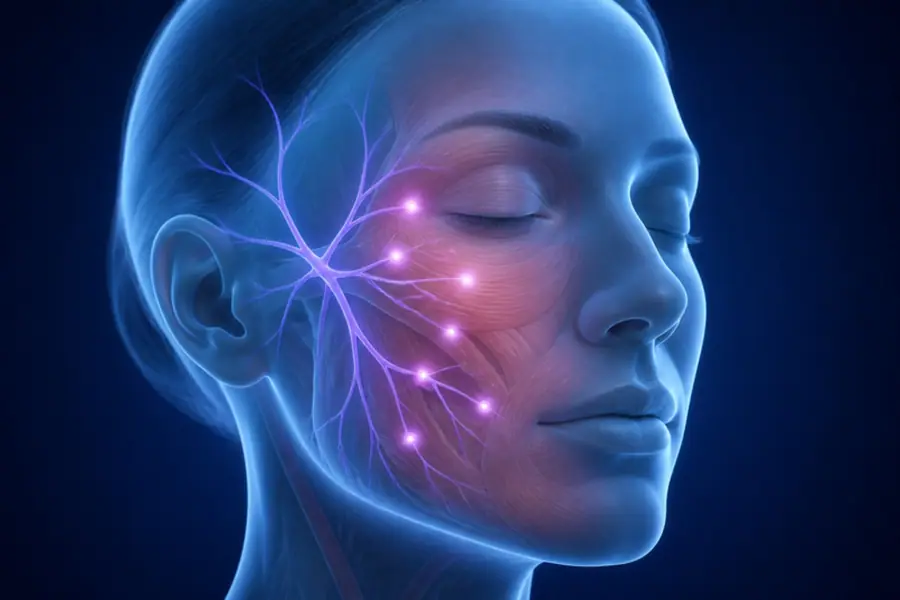
In hemifacial spasm, the muscles on one side of the face twitch involuntarily, usually starting around the eye and spreading to the cheek and mouth. It is usually caused by a blood vessel pressing on the facial nerve. An MRI is recommended to look for this and to exclude other causes.
Cervical dystonia (spasmodic torticollis)
In cervical dystonia, the neck muscles contract involuntarily, causing the head to turn, tilt, or be pulled forward or backward, often with neck pain and head tremor. Many people find that touching the face or the back of the head temporarily reduces the abnormal posture (a “sensory trick”).
How Botox works
Botulinum toxin blocks the release of acetylcholine, the chemical messenger that tells the muscle to contract. Injected in very small, precise doses into overactive muscles, it weakens them in a controlled way and reduces the involuntary contractions. The effect begins within days, peaks after about two weeks and gradually wears off over about three months, when the injections are repeated.
Which conditions is it used for?
- Frequent blinking, eyelid squeezing or difficulty keeping the eyes open
- Sensitivity to light and a sensation of dry or gritty eyes
- Twitching of one side of the face, sometimes continuing during sleep
- Head turning, tilting or jerking; neck pain
- Head tremor
- Writer’s cramp — cramping of the hand when writing
- Symptoms worsening with stress and fatigue and improving with relaxation
Living with blepharospasm
People with blepharospasm often describe being unable to keep their eyes open while walking in the street, watching television or driving, even though their eyesight is normal. Many have seen several eye specialists and used eye drops for years before the correct diagnosis. Wearing tinted glasses, pressing a finger near the eye, humming or talking may temporarily help — these are typical features that support the diagnosis.
Who is Botox for dystonia, blepharospasm and hemifacial spasm suitable for?
- Blepharospasm affecting reading, driving or work
- Hemifacial spasm
- Cervical dystonia
- Other focal dystonias such as writer’s cramp
- People already receiving Botox who want a review of doses or injection sites
Botox is not used during pregnancy and breastfeeding, in certain neuromuscular diseases such as myasthenia gravis, or when there is an infection at the injection site. Some medicines, including certain antibiotics, may increase its effect.
Assessment before the procedure
Before treatment, a detailed neurological examination confirms the diagnosis and excludes other causes. For blepharospasm, eye conditions such as dry eye are considered. For hemifacial spasm, MRI is recommended. In dystonia, medications that can cause abnormal movements are reviewed.
The pattern of muscle involvement is mapped carefully, as the injection plan is individual. In cervical dystonia, ultrasound or EMG guidance may be used to target deeper muscles accurately.
How is Botox for dystonia, blepharospasm and hemifacial spasm performed?
- You sit comfortably; the injection sites are cleaned
- Very fine needles are used to inject small amounts of Botox into the selected muscles
- For blepharospasm, injections are given around the eyelids and eyebrows; for hemifacial spasm, around the eye and in the cheek on the affected side; for cervical dystonia, into the neck muscles responsible for the posture
- The procedure takes 15–30 minutes and does not require anaesthesia
- You can go home immediately and continue normal activities
The doses and injection sites are recorded and adjusted at each session according to the response and any side effects, so that the treatment becomes increasingly tailored to you.
Procedure time and your stay in Istanbul
The effect begins within three to seven days and reaches its maximum after about two weeks. It usually lasts about three months, after which the injections are repeated. A review two to four weeks after the first treatment helps to fine-tune the doses.
For international patients, consultation and injection can be completed in one day in Istanbul. Subsequent sessions can be planned around your travel; a written summary of doses and sites can be provided for a trained doctor in your home country.
After the procedure
- Do not rub or massage the injected areas on the day of treatment
- Avoid lying down for a few hours and strenuous exercise for the rest of the day
- Note how and when the effect starts and wears off
- Report any side effects at the follow-up
- Plan the next session around 12 weeks later
Possible side effects and risks
Side effects are usually mild and temporary. After injections around the eye, there may be drooping of the eyelid, dry or watery eyes, double vision or bruising. After neck injections, temporary neck weakness, difficulty swallowing or neck pain may occur. These effects usually resolve within a few weeks. Serious side effects are rare at the doses used. Very rarely, antibodies may reduce the effectiveness over time; intervals of at least 12 weeks are recommended to minimise this.
Frequently asked questions about Botox for dystonia, blepharospasm and hemifacial spasm
Is Botox for blepharospasm the same as cosmetic Botox?
The substance is the same, but the purpose, doses and injection sites are different. In neurology, Botox is used to treat involuntary muscle contractions and is planned by a neurologist.
How long does the effect last?
Usually about three months. The duration can vary between people and between sessions.
Does it hurt?
Very fine needles are used. Most people feel brief stinging; no anaesthesia is needed.
Will Botox cure my dystonia?
Botox does not cure dystonia, but it controls symptoms effectively for as long as treatment continues. Some people experience longer periods of improvement.
Can hemifacial spasm be treated surgically?
Yes. Microvascular decompression can relieve the pressure of the blood vessel on the facial nerve. Botox is the most common treatment, and surgery is an option for selected patients.
Can I drive after the injections?
Yes, usually. If you develop eyelid drooping or double vision, avoid driving until these resolve.
Why should the interval be at least 12 weeks?
Repeating injections too frequently may increase the risk of antibody formation, which can reduce effectiveness over time.
Can the injections be continued in my home country?
Yes. A written summary of the doses and injection sites can help a trained doctor at home to continue treatment.
Are there other treatments for dystonia?
Medicines, physiotherapy and, for severe generalised or cervical dystonia that does not respond to Botox, deep brain stimulation may be considered.
Can Botox be combined with medicines for dystonia?
Yes. In some people, oral medicines are added to Botox, particularly when dystonia affects several areas. The combination is planned carefully to limit side effects such as drowsiness.
Can stress cause blepharospasm or hemifacial spasm?
Stress does not cause these conditions, but it can make the spasms more frequent and intense. Relaxation, adequate sleep and treatment of dry eyes can help alongside Botox.
This page is for general information only and does not replace a medical consultation. Please consult a physician for diagnosis and treatment. Results vary from person to person.